
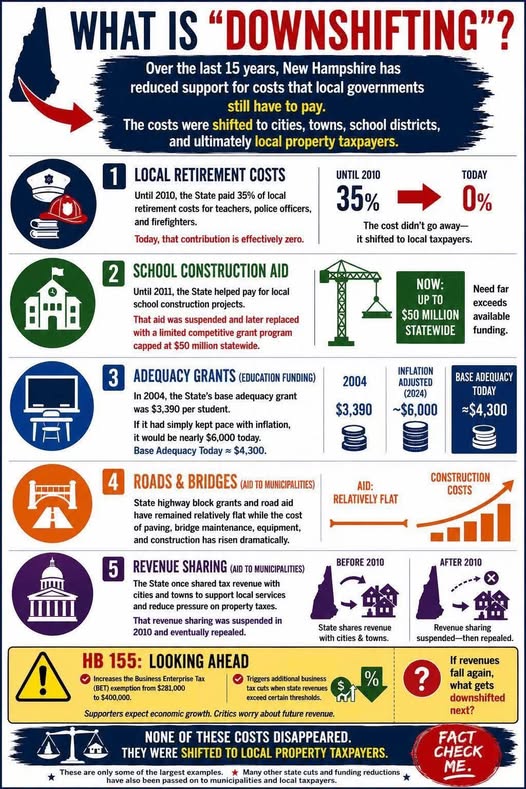
What Is Downshifting—and Why It Should Alarm Every Homeowner
A critical economic bait-and-switch is taking place across our nation, most acutely felt in states like New Hampshire. Under the guise of “fiscal responsibility” and “local control,” state leaders are engaged in a predatory practice known as downshifting.
Downshifting occurs when state or federal governments deliberately reduce their financial contributions to shared public programs, slash revenue-sharing agreements, or pass down expensive regulatory mandates without funding them. It is not an expansion of freedom; it is a calculated transfer of debt from the state capitol to our town. By abdicating its financial duties, the state forces municipalities, school districts, and counties to pick up the tab. The result is a crushing rise in local property taxes and severely strained community budgets.
The Hidden Scale: How Billions Are Pushed Onto Local Budgets
The numbers reveal the sheer magnitude of this systemic cost-shifting. Over a single decade, a state government can quietly transfer billions of dollars in obligations onto local entities.
Consider the stark reality of this fiscal burden:
- School Districts (≈70%): Bear the overwhelming majority of the shifted costs, starving classrooms to balance books.
- Municipal Governments (≈20%): Forced to overextend local town budgets to cover basic civic infrastructure.
- County Governments (≈10%): Left to absorb the remaining deficit, primarily straining local correctional and human service systems.
Because school taxes typically comprise two-thirds of a homeowner’s property tax bill, the state’s targeted reduction in education aid inflicts the deepest damage on everyday citizens.
The Warfare on Public Education and Infrastructure
This political strategy relies on death by a thousand cuts. Rather than funding public systems to match actual inflation and societal needs, the state defunds them through highly specific mechanisms:
- Underfunding Special Education: Forcing local districts to legally comply with federal mandates using purely local funds.
- Shifting Charter Tuition Obligations: Mandating that local taxpayers foot the bill for alternative schooling models without state reimbursement.
- Slashing Adequacy Aid: Lowering the baseline funding required to keep public schools operational.
- Eliminating Retirement Contributions: Abruptly canceling the state’s traditional share of municipal pension costs, leaving towns entirely liable for the retirement security of first responders and public servants.
Seniors and Families Sidelined: The Human Cost of Rising Property Taxes
Downshifting leaves local communities trapped in a catastrophic paradox. Municipalities do not have the luxury of printing money, nor do they possess broad taxing powers. When the state defaults on its promises, local governments are forced to choose between two unsustainable options:
- Explosive Property Tax Hikes: This directly punishes homeowners, devalues middle-class equity, and prices working families out of their homes.
- Severe Service Reductions: This forces towns to gut public safety, delay vital road infrastructure, and degrade the quality of local schools.
disproportionately impacts vulnerable populations. Seniors on fixed incomes face displacement due to skyrocketing property taxes, while low-income families and children lose access to vital safety nets and quality public education.
The Tactics: How States Shift Costs While Claiming “Fiscal Responsibility”
Leaders such as House Majority Leader Jason Osborne and Senate Majority Leader Regina Birdsell (Derry’s Senate representative) have publicly argued that the state is not downshifting costs. They claim the state is sending “more money than ever” to towns and that rising property taxes are due to local spending decisions, not state cuts. Many republican state reps, not necessarily Derry’s, argue that the state has increased aid and that downshifting is a political talking point.
Debunking Denial: What Leaders Say vs. What Towns Actually Pay
Senator Birdsell is correct that the state is sending more dollars than it used to, but it has simultaneously shifted burdens onto local towns. By withdrawing from retirement contributions and underfunding education, the state ensures that its increased aid doesn’t even come close to covering the new deficits. State leaders take credit for “balancing the state budget” while local taxpayers pay double to maintain the exact same baseline services.
Conclusion: A Call for Reinvestment
Downshifting is a cowardly form of governance. It allows state politicians to brag about cutting state taxes while covertly forcing local property taxes to historic highs. It hollows out public education, compromises public safety, and breaks the foundational compact between a state and its citizens.
To restore economic fairness and long-term community stability, we must reject the politicians who champion these corporate tax giveaways and wealthy handouts at the expense of our towns. We must elect leaders who view governance as a fair partnership—leaders committed to fully funding our schools, honoring our pension obligations, and protecting property owners from carrying the state’s financial burdens alone.