
If you live in Derry, you already know this: school funding decisions don’t stay in Concord—they come home through the school budget and ultimately through our property tax rate. That’s why the state’s Hold Harmless Grants phaseout matters. This phaseout starts in State Fiscal Year (SFY) 2026.
Derry needs leaders in Concord focused on protecting school funding stability—not just proposals that cap budgets.
What Hold Harmless Grants are for
Concord created the Hold Harmless Grants as temporary protection to prevent sudden drops in state education aid when New Hampshire’s education funding system changed after the ConVal v. State ruling. Instead of communities losing support immediately and “all at once,” the state provided a transition cushion designed to slow the impact for districts that would otherwise face a steep reduction.
The grants ease the transition—not eliminate the underlying funding gap.
The phaseout begins in this school year
For Derry, this isn’t hypothetical. It arrives during a period when school budgets are already under pressure from staffing, transportation, special education requirements, and rising operating costs, including health care and utilities needed to run schools.
Why a grant phaseout still becomes a local responsibility
Here’s the key point: school districts must fill the gap when the state reduces funding. Data from the New Hampshire Fiscal Policy Institute (NHFPI) explicitly highlights Derry as experiencing one of the largest net dollar aid decreases in the entire state. That typically means at least one of the following:
- shifting more cost to local taxpayers,
- reducing or changing programs and services,
- making staffing decisions that affect students and families,
- or cutting in ways that become more disruptive over time.
Derry will feel the consequences when the funding cushion disappears and the district has to absorb the difference.
Why Derry is affected more than “property-rich” communities
It’s not just about how much the state gives. It’s also about how New Hampshire’s funding formula measures local capacity—using local property wealth measures tied to students.
Derry’s position under the formula makes the transition risk more significant than it is for wealthier communities. The Hold Harmless grants function like a bridge: if the bridge is removed while school costs continue, the associated expenses do not go down.
Derry is not considered “Property-Rich”
To understand why the Hold Harmless phaseout is uniquely harmful to Derry, look at how the state defines education funding capacity using Equalized Property Value per Pupil (EQPP).
Property-rich communities—often with large commercial tax bases, luxury waterfront property, or major utilities—have a larger tax base relative to their student counts. Derry fits the opposite profile: a mid-sized, middle-class suburban town with a robust public school enrollment, but without the same concentration of high-value commercial real estate or waterfront property.
As a result, Derry’s equalized property value per student sits significantly below the state median. That means Derry must rely on higher local property tax rates than affluent neighbors just to reach baseline classroom funding.
EQPP comparison: Derry vs. Londonderry
To illustrate how EQPP translates to local funding capacity, consider Londonderry vs. Derry.
Derry and Londonderry population
Derry is the 4th most populous town/city in NH with roughly 33,990 residents, meanwhile; Londonderry is the 9th most populous town/city in NH with roughly 27,844 residents.
EQPP per pupil comparison (Londonderry vs. Derry):
| Town | Total Equalized Property Valuation | Student Enrollment (ADM-R) | Equalized Property Value Per Pupil |
| Londonderry | $7,522,892,794 | ~3,734 students | $2,014,641 |
| Derry | $6,256,276,413 | ~4,586 students | $1,364,266 |
Because Londonderry has roughly $1.26 billion more in overall equalized property value while educating about 850 fewer students, its tax base per child is substantially stronger than Derry’s.
EQPP per capita: the broader tax base picture
Enrollment was the focus in the previous chart, but looking at the tax base across the broader population provides additional context.
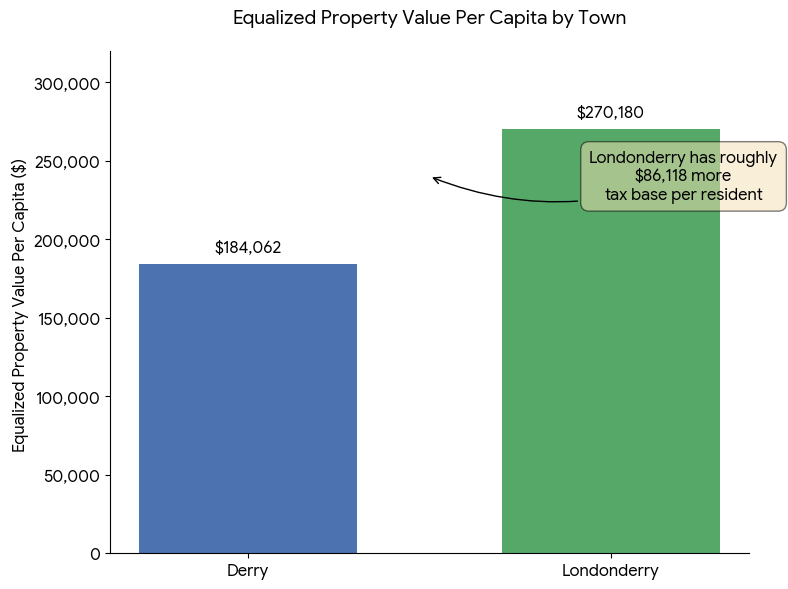
EQPP per capita comparison:
| Town | Total Equalized Property Valuation | Total Population | Equalized Property Value Per Capita |
| Londonderry | $7,522,892,794 | 27,844 | $270,180 |
| Derry | $6,256,276,413 | 33,990 | $184,062 |
Even when looking at the entire population rather than just school enrollment, Londonderry holds a significantly stronger tax advantage, with about $86,118 more in property wealth per resident than Derry.
What does this mean
Even when using population rather than student enrollment, Londonderry still has a materially stronger advantage—about $86,118 more in property wealth per resident than Derry.
What this means for property taxes
Because Londonderry has a broader base, it can raise property taxes by a smaller amount to generate the same revenue. Derry doesn’t have that same cushion—so when state support declines, the pressure lands more directly on local budgets and property taxes.
Come back for Part 2, because that’s where the details turn into our property taxes going up.
References / Citations
- [1] New Hampshire Fiscal Policy Institute (NHFPI). (2026). New Hampshire’s Education Funding Transition Means Reduced Aid for 109 Communities. NHFPI Resource Page.
- [2] New Hampshire School Funding Fairness Project. (2024). School Funding and Property Taxes. Fair Funding NH Archive.
- [3] Union Leader. (2026). Derry voters approve school budget; incumbents return to town, school office. Manchester Union Leader Local Report.