
In 1923, New Hampshire created a tax targeted at wealthy residents in the state: the “Interest & Dividend” (I&D) tax. In 2021, Republicans—having taken control of all branches of government—began phasing out the tax by reducing it by 1% each year until it reached zero in 20271. In 2023, Republicans accelerated the repeal so that 2024 would be the final year the tax would apply2.
What was this tax?
Because only about 10% of people paid the I&D tax3, many residents were likely unaware of how it worked. Individuals who earned more than $2,400, or joint filers who earned more than $4,800, from interest, dividends, or distributions were taxed on every dollar above the exemption amount.
Before 2024, the tax rate was 5%; in 2024, it was reduced to 4%.
This tax did not apply to retirement accounts such as 401(k)s and IRAs, college savings plans (for example, 529 plans), standard pensions, and several other forms of savings. As a result, most people would never have had to pay this tax because they did not have qualifying non-retirement savings or investment income at those levels.
Example: how the tax worked
Assume you had a savings account earning 5%. To earn exactly $4,800 in interest, you would need $96,000 (because $4,800 ÷ 0.05 = $96,000) in the account.
In that scenario, filing jointly would mean you would not owe any tax, since your interest would match the exemption amount.
If your savings balance were $100,000, you would earn $5,000 in interest. Since $4,800 is exempt, the taxable amount would be:
$5,000 − $4,800 = $200
Applying the 5% rate to the taxable amount:
$200 × 0.05 = $10
This example illustrates that the I&D tax primarily affected people who held large amounts of money in interest-earning accounts.
In 2020, most individuals paying this tax earned between $1,000 and $50,000 in interest or dividends after deductions.
How much revenue did the state lose?
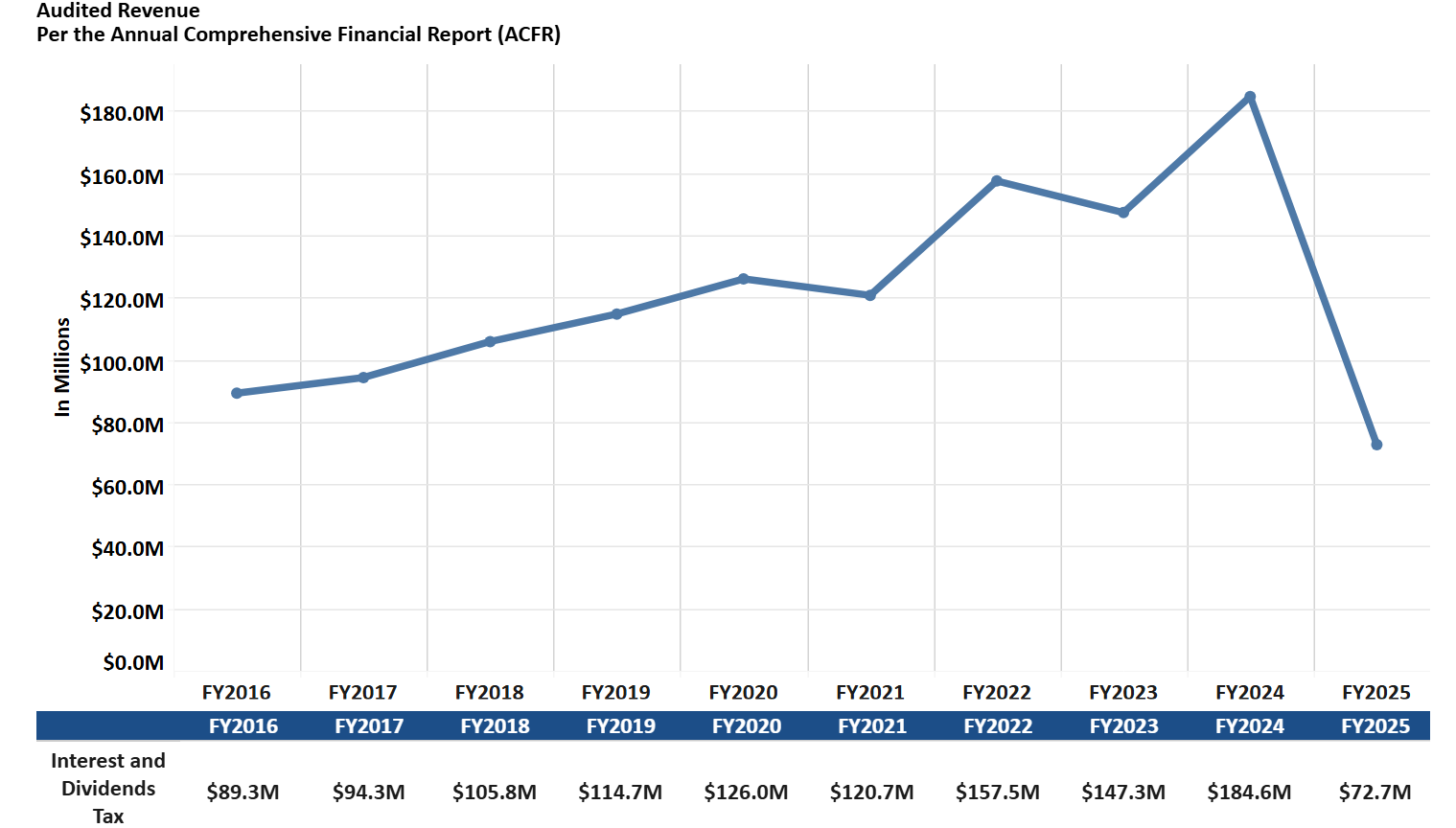
The phaseout reduced tax revenue by approximately $100 million per year. Below is a summary of revenue over the last 10 fiscal years:
| Fiscal Year4 | I&D Rate | Revenue5 |
| 2016 | 5.00% | $89,300,000.0 |
| 2017 | 5.00% | $94,300,000.0 |
| 2018 | 5.00% | $105,800,000.0 |
| 2019 | 5.00% | $114,700,000.0 |
| 2020 | 5.00% | $125,700,000.0 |
| 2021 | 5.00% | $120,700,000.0 |
| 2022 | 5.00% | $157,500,000.0 |
| 2023 | 4.00% | $147,300,000.0 |
| 2024 | 3.00% | $184,300,000.0 |
| 2025 | 0.00% | $0 |
| 2026 | 0.00% | $0 |
After reducing this tax income, Republicans sought to cover the shortfall by cutting spending and increasing fees, fines, and other revenue sources, including lottery returns, insurance premium taxes, and expanded gambling operations.
How did spending get cut?
Overall, state spending was reduced by 3.5%, which officials characterized as being done “thoughtfully and carefully.”6
One described approach was requiring Medicaid recipients to pay co-pays or monthly premiums. While some may believe Medicaid enrollees should pay out of pocket, Medicaid is typically intended for individuals who are low-income and/or medically unable to work—often because they are poor and chronically ill.
Obtaining Medicaid can also be difficult in practice. Applicants may need to complete extensive paperwork, provide documentation such as bank statements and tax returns, and demonstrate eligibility. If income exceeds a certain threshold, individuals will be directed to the ACA Healthcare Portal, where they are required to purchase their own insurance.
What fees and fines were increased?
Examples of fees and charges described include vanity license plates, vehicle titles, car registration, and an automotive oil fee.
The bottom line
The Republican phase out of the Interest & Dividend tax directly provided tax relief for wealthy residents. At the same time, budgets were reduced and fees were increased—changes that affect all of us.
Conclusion
This tax should be reinstated, and the revenue should be dedicated specifically to funding public education. Doing so would also, to a modest extent, reduce property taxes for residents.
Footnotes
- https://arbcpa.com/new-hampshire-ends-interest-dividends-tax-for-now-a-detailed-look-at-the-repeal-and-potential-return/ ↩︎
- https://www.revenue.nh.gov/news-and-media/repeal-nh-interest-and-dividends-tax-now-effect ↩︎
- https://nhfpi.org/blog/households-with-high-incomes-disproportionately-benefit-from-interest-and-dividends-tax-repeal/ ↩︎
- NH’s Fiscal Year runs from July 1 of the previous year to June 30 of the current year ↩︎
- https://www.revenue.nh.gov/transparency/transparency-all-tax-types/transparency-interest-dividends-tax ↩︎
- https://www.das.nh.gov/budget/Budget2026-2027/Governor_Executive_Summary_FY_2026-2027.pdf ↩︎